Devoxar
Drift Suite
Drift Suite
Couldn't load pickup availability
Self-paced learning overview
- 📥 Downloadable PDF materials
- 📖 Designed for independent study
- 🔒 Secure checkout
- 🗓️ Materials reviewed in 2026
1. Problem Statement
Struggling to organize code when data changes at different times and depends on several events? You’re not alone. Many learners work well with structures and functions but face difficulties when they need to track state, wait for an operation, or handle several possible results. This can make the logic harder to follow and the execution order less clear. Drift Suite explains how to describe states, events, and asynchronous processes through separate components. The course is intended for learners who want to move from static examples to scenarios where data changes during execution.
2. Solution
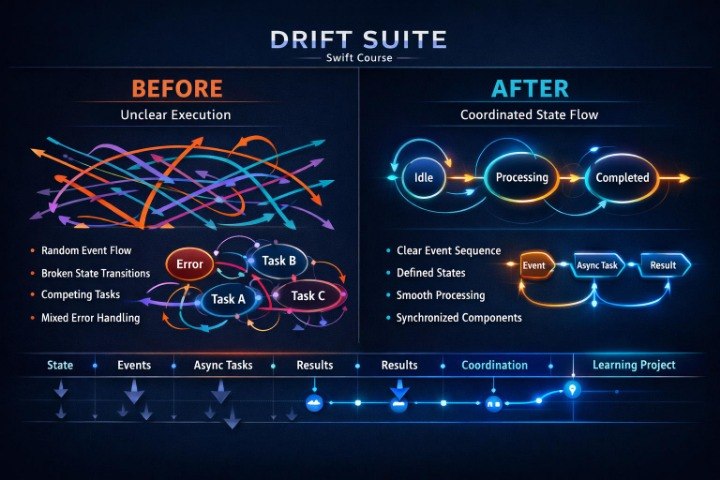
This course will teach you how to build logic that accounts for state changes, delays, event order, and different execution results. You will explore how to describe state through enumerations and models and how to pass updates between connected parts of the code. The materials explain asynchronous operations, error handling, and task coordination without placing several responsibilities inside one block. Drift Suite includes topic-based examples, multi-stage exercises, and a final scenario with dynamic data updates. The course develops a clearer understanding of how code responds to events and changing values.
3. What’s Inside
Module 1: State Modeling
Creating models that describe the current state of a program. You will explore how enumerations and associated values can represent different stages of execution.
Module 2: Event-Driven Logic
Working with events that trigger changes in code. This module explains how to separate the event source from the logic that responds to it.
Module 3: Asynchronous Foundations
An introduction to operations that do not finish immediately. You will learn how to describe waiting for a result while maintaining a clear action sequence.
Module 4: Tasks and Execution Order
Working with tasks and their execution sequence. You will explore how to start several operations and define what should happen after they finish.
Module 5: Error Handling
Handling errors through separate scenarios. This module shows how to describe possible issues and pass error information without excessive condition checks.
Module 6: Result-Based Models
Creating models for storing different operation results. You will learn how to separate received data from error information or missing values.
Module 7: State Transitions
Describing transitions between an initial state, active processing, completion, and error. This module makes dynamic logic easier to follow.
Module 8: Coordinating Components
Coordinating several models, functions, and tasks. You will explore how to pass updates between components without creating overly tight connections.
Module 9: Async Practice Tasks
Practice tasks involving asynchronous scenarios, state handling, delays, and different operation results.
Module 10: Dynamic Flow Project
A final task where you create a scenario with several states, an asynchronous operation, error handling, and structured data updates.
4. Who Is This For?
✅ A suitable choice if you:
- already work with structures, protocols, and generic types;
- want to understand asynchronous logic more clearly;
- want to describe changing states in code;
- want to separate events, data, and result handling;
- are ready for tasks with several execution stages.
❌ This course may not suit you if you:
- are not yet familiar with functions, models, and enumerations;
- are looking for an introductory syntax course;
- do not plan to work with asynchronous scenarios;
- already build complex state management systems regularly.
5. What You’ll Learn
- Create models for different program states.
- Separate events from their handling logic.
- Understand the execution order of asynchronous operations.
- Work with tasks and result waiting.
- Describe and handle different error types.
- Create models for operation results.
- Define transitions between several states.
- Coordinate connected components.
- Complete at least ten practical tasks.
- Build one learning scenario with a dynamic data flow.
6. Course Review Terms
Drift Suite includes structured course materials for independent learning. If the course does not meet your expectations, you may request a refund within 30 days according to the store policy. This gives you time to review the materials and decide whether the course format fits your learning needs.
Who are Devoxar courses for?
Who are Devoxar courses for?
Devoxar courses are for learners who want to study Swift programming through structured materials, examples, and practical tasks.
Do I need previous experience?
Do I need previous experience?
Previous experience is not required for the starting tiers. Topics are presented gradually, from basic concepts to broader sections.
What is included in the learning materials?
What is included in the learning materials?
The materials may include modules, explanations, code examples, independent practice tasks, and short summaries.
Share