Devoxar
Loom Suite
Loom Suite
Couldn't load pickup availability
Self-paced learning overview
- 📥 Downloadable PDF materials
- 📖 Designed for independent study
- 🔒 Secure checkout
- 🗓️ Materials reviewed in 2026
1. Problem Statement
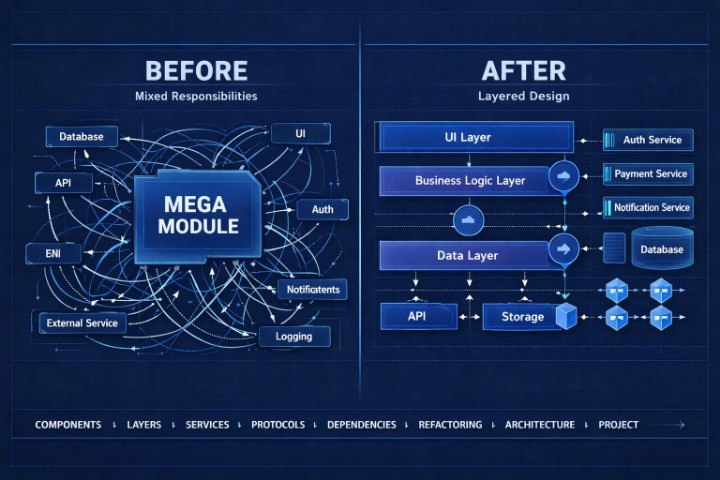
Struggling to keep Swift code understandable when a learning project contains many models, states, and connected actions? You’re not alone. As code grows, individual components often begin handling too many tasks at the same time. This makes reading, reviewing, and changing separate parts of the logic more difficult. Loom Suite explains how to divide larger scenarios into smaller components with defined roles. The course supports the transition from separate learning examples to a more connected structure with several related layers.
2. Solution
This course will teach you how to organize Swift code through separate models, services, handlers, and coordinating components. You will explore how to divide work with data, states, events, and logical rules between different parts of the structure. The materials explain how to reduce excessive connections and pass data through defined interaction points. Loom Suite includes structured examples, code reorganization tasks, and a final assignment involving several components. The course develops a more systematic understanding of larger learning projects.
3. What’s Inside
Module 1: Component Responsibilities
Defining the role of each component in a code structure. You will learn how to identify parts that contain too much logic and divide them into smaller sections.
Module 2: Layered Code Structure
Organizing data, rules, and state handling across different layers. This module shows how to maintain a clear direction for information movement.
Module 3: Dependency Basics
Working with dependencies between models and services. You will explore how to provide required components without creating hidden connections.
Module 4: Service-Oriented Logic
Moving data processing and repeated operations into separate services. You will see how this keeps models focused on their own tasks.
Module 5: Coordinators and Flow Control
Creating components that manage transitions between several scenarios. This module explains how to separate action order from data processing.
Module 6: Protocol-Based Connections
Using protocols to define interaction rules between components. You will learn how to create connections without relying too heavily on specific types.
Module 7: Refactoring Large Blocks
Dividing large code sections into smaller parts. You will explore how to find repetition, mixed responsibilities, and unclear boundaries.
Module 8: Testing Logic in Isolation
Preparing individual logic components for independent review. This module shows how predictable input and output values simplify behavior analysis.
Module 9: Multi-Component Practice
Practice tasks where you combine models, services, protocols, and coordinating components.
Module 10: Structured Course Project
A final assignment with several layers, data movement, states, and separate areas of responsibility.
4. Who Is This For?
✅ A suitable choice if you:
- already work with protocols, models, and asynchronous logic;
- want to structure larger sections of code;
- want to divide responsibilities between components more clearly;
- want to reduce excessive connections between types;
- are ready to reorganize code and explain the role of each part.
❌ This course may not suit you if you:
- are only beginning to study Swift programming;
- have not yet worked with protocols, states, and models;
- are looking for a course focused only on basic syntax;
- do not plan to complete code reorganization tasks.
5. What You’ll Learn
- Divide larger scenarios into smaller components.
- Define separate roles for models, services, and coordinators.
- Organize code across several logical layers.
- Provide dependencies through defined interaction points.
- Use protocols for communication between components.
- Identify mixed responsibilities and repeated logic.
- Reorganize large blocks into clearer sections.
- Prepare individual components for independent review.
- Complete at least ten practical tasks.
- Build one learning project with several connected layers.
6. Course Review Terms
Loom Suite includes structured course materials for independent learning. If the course does not meet your expectations, you may request a refund within 30 days according to the store policy. This gives you time to review the materials and decide whether the course format fits your learning needs.
Who are Devoxar courses for?
Who are Devoxar courses for?
Devoxar courses are for learners who want to study Swift programming through structured materials, examples, and practical tasks.
Do I need previous experience?
Do I need previous experience?
Previous experience is not required for the starting tiers. Topics are presented gradually, from basic concepts to broader sections.
What is included in the learning materials?
What is included in the learning materials?
The materials may include modules, explanations, code examples, independent practice tasks, and short summaries.
Share